
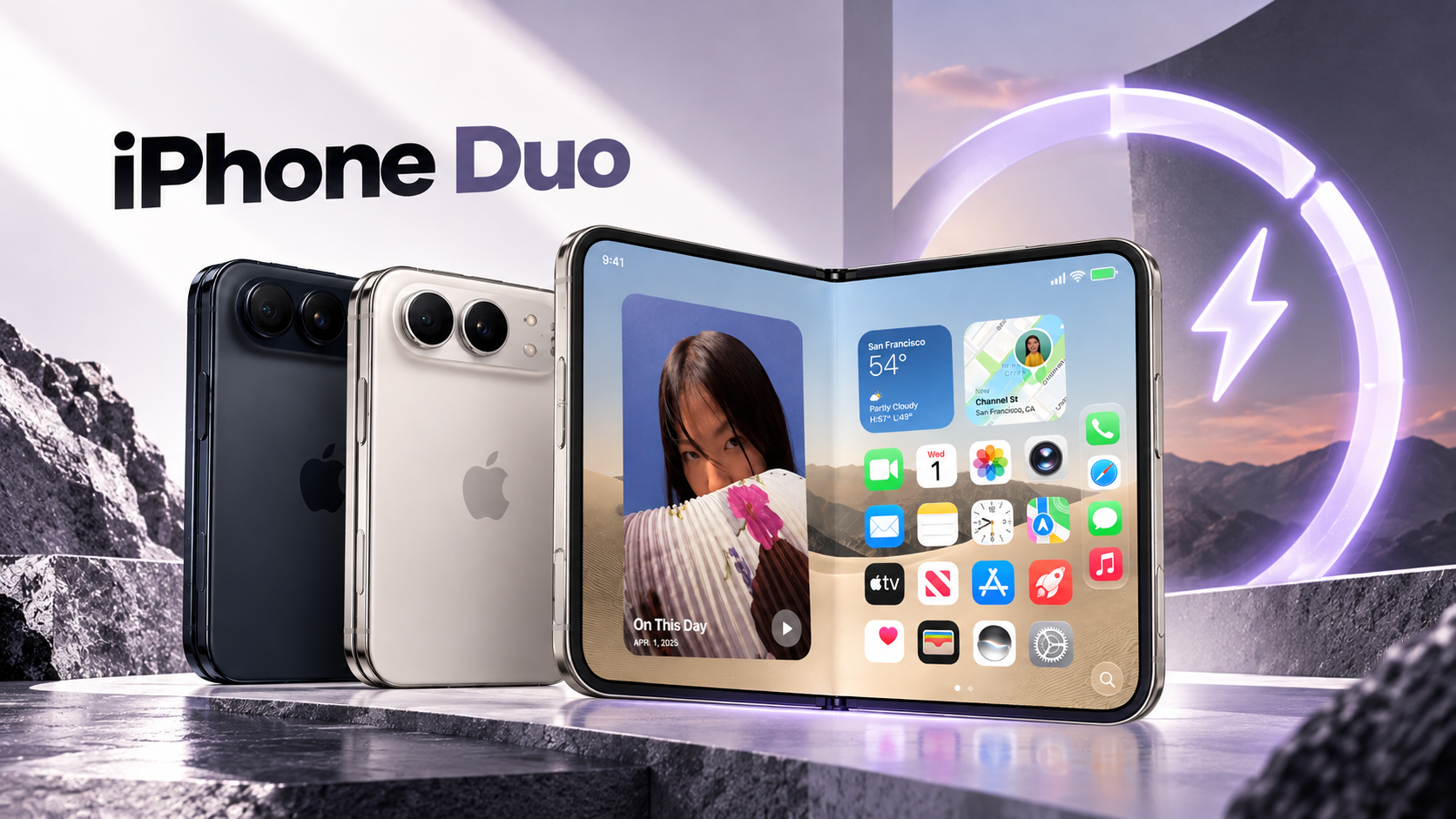
The best charger for the iPhone Duo is a USB Power Delivery charger with a power of at least 60 W, only from this threshold does Apple promise to charge up to 50% in about 20 minutes. Our choice is the UGREEN Nexode Air 65W, as it fits this power on one port and is the size of a matchbox.
In the box with the phone, you will find only a USB-C cable. There is no charger, and the old 20 W cube from the iPhone 12 will charge the Duo noticeably slower than the manufacturer states.
The foldable iPhone goes on sale on October 23, 2026, with pre-orders starting on October 16. This is a good time to choose a charger in advance, instead of looking for it after receiving the package.
Below are five wall chargers that meet this threshold, and further on all the other equipment: MagSafe and Qi2 25W wireless chargers, USB-C cables, car chargers, and power banks. Along the way, four things on which it’s easiest to lose the promised 20 minutes.

The iPhone Duo charges via USB-C and wirelessly, using MagSafe and Qi2 standards. Photos: Apple.
Note: The iPhone Duo is not the MagSafe Duo
Before we move on to the ranking, one distinction that is easy to overlook when purchasing.
MagSafe Duo Charger is a foldable, dual charger from Apple for the iPhone and Apple Watch, introduced in 2020 and long discontinued. The name „Duo” refers to its two charging pads, not a phone model.
iPhone Duo is a foldable iPhone from 2026, which we described in the premiere article about the foldable iPhone. It requires a regular USB-C wall charger, but one that is more powerful than previous iPhones.
If you see „Apple dual charger,” „Apple Duo Charger,” or „Apple Duo wireless charger” in the search engine, it is not a product for this phone.
Are you looking for such a dual charger? Its modern equivalent is 3-in-1 stations: they charge the phone, watch, and headphones at the same time, and unlike the MagSafe Duo, they are still available for purchase. We describe them in the section on wireless chargers later in the text.
What the iPhone Duo requires from a charger
Apple provides three numbers in the specifications, and all three are important when making a purchase.
| Parameter | Value according to Apple |
|---|---|
| Wired fast charging | up to 50% in about 20 minutes |
| Minimum power of the power adapter | 60 W or higher |
| MagSafe charging | up to 25 W |
| Qi2 charging | up to 25 W |
| MagSafe charging to 50% | about 30 minutes, power adapter 35 W or stronger |
| Connector | USB-C, USB 3 (10 Gb/s) |
| Included | 1 m USB-C cable, no power adapter |
| Phone weight | 254 g |
Note one thing: 60 W is a requirement for the power adapter, not the power drawn by the phone. The Duo does not draw 60 W continuously. However, the power adapter must have that reserve to maintain a high current in the initial phase of charging when the battery is nearly empty.
This is a change compared to the rest of the line. The iPhone 17 reaches its 50% in 20 minutes with a 40 W power adapter, which we described in the ranking of chargers for the iPhone 17. The Duo has two batteries and raises this threshold by half.
Need a charger right now? See phone chargers →
Four things that determine full speed
1. Power on one port, not total
This is the most common trap with multi-port chargers. The manufacturer writes „65 W” on the box, but that number refers to the total across all ports. Plug in a second device, and the main port drops to 45 W or lower, and the phone falls below the 60 W threshold.
Look for specifications that state „65 W on a single USB-C port.” If you are charging a laptop and a phone from one block, go for a higher power tier: 100 W or more.
2. USB Power Delivery, not just Quick Charge
The iPhone exclusively uses USB Power Delivery (USB PD), a standard that negotiates voltage between the charger and the device. Quick Charge is Qualcomm’s competing standard, useful for Android phones, but it offers nothing to the iPhone.
Most GaN chargers support both at the same time. Just make sure that USB PD is explicitly mentioned.
3. GaN, if size matters to you
GaN (gallium nitride) is a material that has replaced silicon in charger transistors. It heats less and allows for fitting 65 W in a case the size of the old 20 W block.
At 60 W and above, it’s the difference between something that fits in your jacket pocket and a brick for your backpack.
4. The cable that no one mentions on the box
Manufacturers of chargers are silent about this because the cable is usually sold separately. At 60 W, the cable must carry 3 A, and not every cable can do that, even if the plug looks identical. We will return to this in a separate section below.
The cable from the Duo box performs flawlessly. The problem starts when you reach for the first random cable from the drawer, and then you wonder why 20 minutes turned into an hour.
Ranking: 5 chargers for iPhone Duo that meet the 60 W threshold
We have ranked them from the most universal to the most specialized.
The phone will be available for sale only on October 23, so we selected them based on the parameters provided by Apple, not on our own tests with this model.
1. UGREEN Nexode Air 65W
Our choice
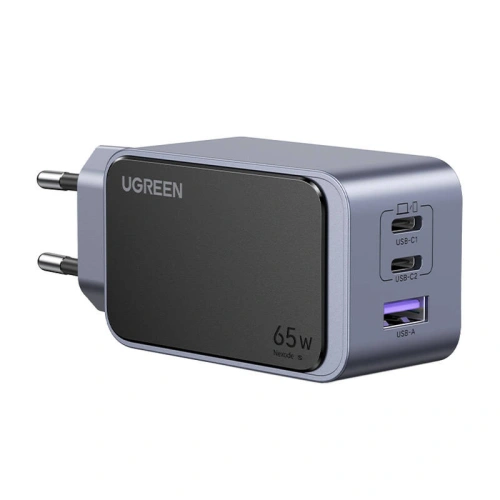
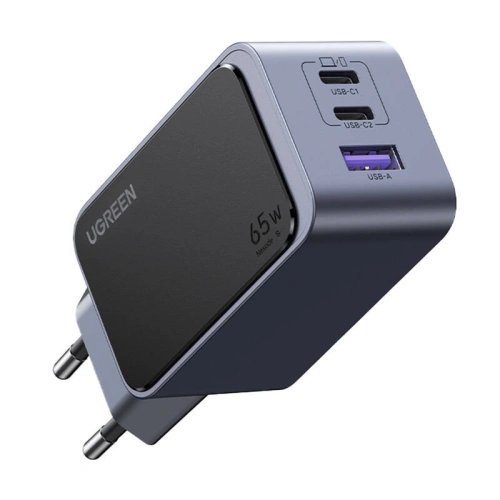
UGREEN Nexode Air 65W exceeds the 60 W threshold with a small margin and does so in a casing that you can easily carry in your backpack pocket. It has two USB-C ports and one USB-A, so you can also charge your headphones or watch from it.
You will get a full 65 W with one connected device. When you plug in a second one, the power is divided between the ports, and Duo may drop below the required 60 W. This is not a flaw of this specific model, but a feature of all multi-port chargers in this power class.
For most people who want one cube for their phone and occasionally something else, this is the most sensible choice from the entire lineup.
2. Spigen Essential EE673EU 67W
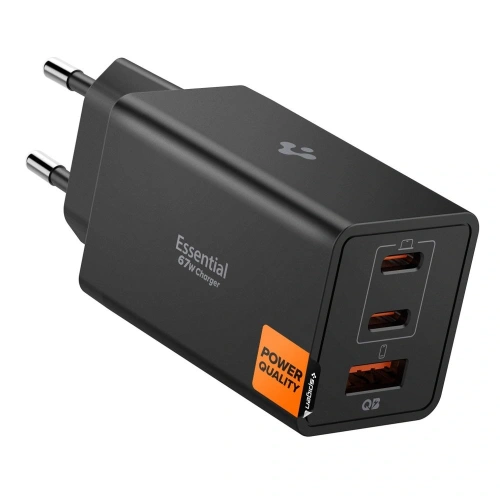
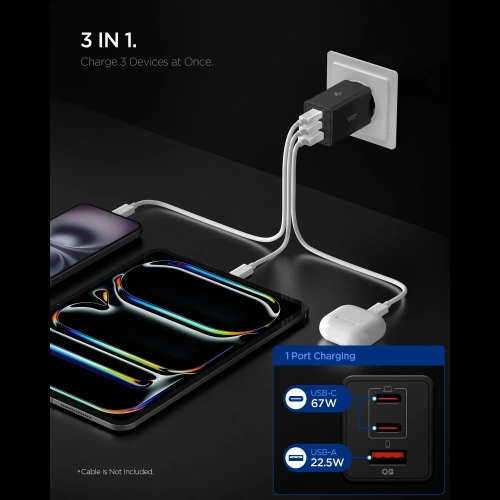
Spigen Essential EE673EU provides 67 W, which is seven watts above the required threshold. This surplus makes sense: when charging a phone and a second small device simultaneously, you have a better chance that Duo will maintain full speed.
The port layout is identical to the UGREEN proposal: two USB-C and one USB-A. The black casing is less conspicuous at the socket than a typical white cube.
3. USAMS JC Series CC266 65W GaN
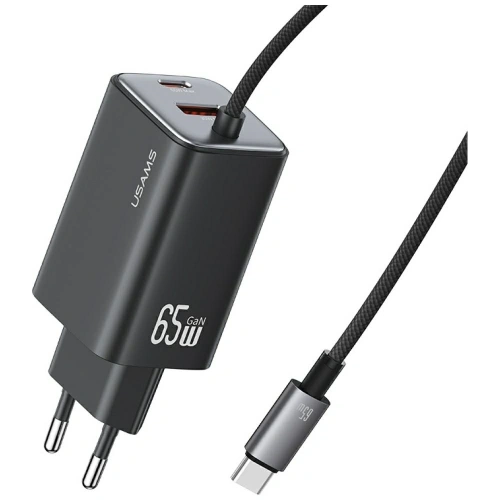
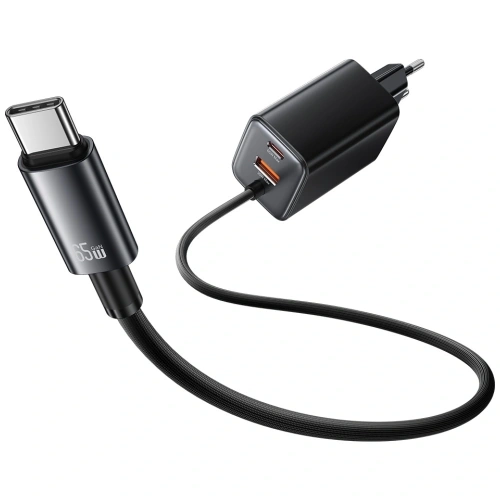
USAMS JC Series CC266 65W GaN is the simplest way to reach 60 W without paying extra for a recognizable logo. Three ports, GaN technology, and the same 65 W as the competition from the higher tier.
If the charger is going to sit behind the couch and no one will look at it, this model does exactly the same job.
4. Tech-Protect PowerVision NC100W GaN
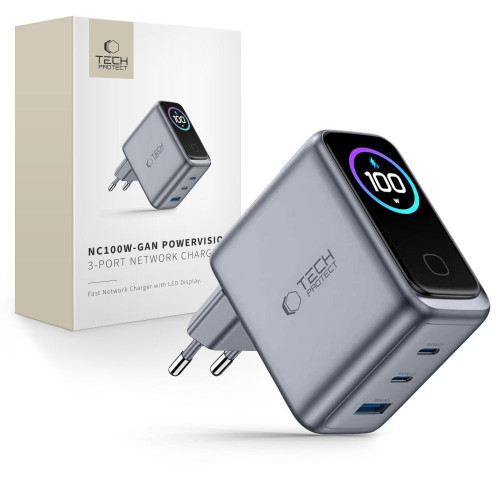
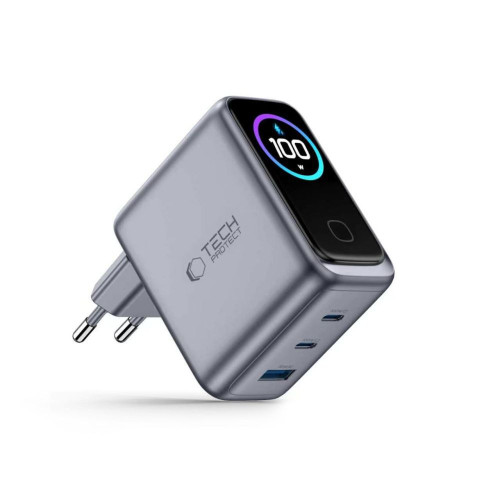
Tech-Protect PowerVision NC100W solves the problem we mentioned above: it shows on a small display how many watts are actually flowing to the phone.
This is the only way to see for yourself whether the Duo is getting the promised 60 W, or if the cable or the second connected device has reduced the power. With a phone that has such specific requirements, this information is worth more than with an ordinary smartphone.
One hundred watts also provides a real reserve when using two devices at once, and is sufficient for most laptops with USB-C.
5. Satechi 4-Port GaN Travel Charger 140W
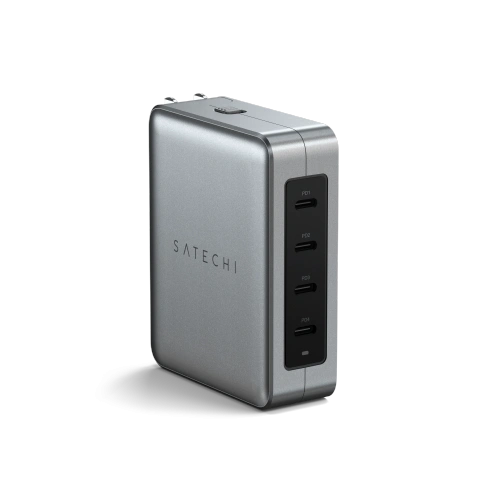
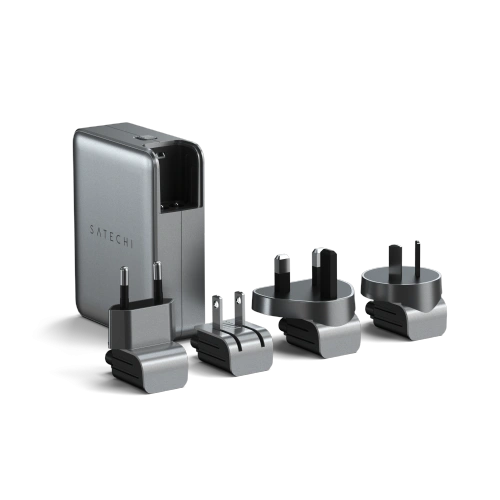
Satechi 4-Port GaN Travel Charger 140W is a proposal for someone who travels a lot. Four USB-C ports and interchangeable plugs in American, British, European, and Asian standards replace an entire bag of adapters.
With 140 W to share, even three connected devices won’t push the phone below the threshold. If you’re also carrying a MacBook, it’s the only brick you need. For those who prefer a permanent setup on their desk, the same manufacturer offers Satechi GaN Charger 165W with four USB-C ports.
60 W and stronger chargers for iPhone Duo


Comparison of chargers for iPhone Duo
| Model | Power | Ports | GaN | Power Display | Interchangeable Plugs |
|---|---|---|---|---|---|
| UGREEN Nexode Air | 65 W | 2× USB-C + USB-A | ✅ | ❌ | ❌ |
| Spigen Essential EE673EU | 67 W | 2× USB-C + USB-A | ✅ | ❌ | ❌ |
| USAMS JC CC266 | 65 W | 2× USB-C + USB-A | ✅ | ❌ | ❌ |
| Tech-Protect PowerVision NC100W | 100 W | 2× USB-C + USB-A | ✅ | ✅ | ❌ |
| Satechi 4-Port Travel | 140 W | 4× USB-C | ✅ | ❌ | ✅ |
Duo Induction Chargers for iPhone: Qi2, Qi2 25W and MagSafe
Duo charges wirelessly with power up to 25 W: via MagSafe or via Qi2 in the 25 W version, which the Wireless Power Consortium designates as Qi2 25W. So you don’t have to look for accessories with the Apple logo, but you need to pay attention to the power, as older Qi2 chargers are limited to 15 W.
The names of the standards get mixed up in store descriptions, so a brief clarification:
| Standard | Power for iPhone | Magnets | What it means in practice |
|---|---|---|---|
| Qi (old) | 7.5 W | ❌ | The phone needs to be aligned with the coil, charges slowly |
| Qi2 (first version) | up to 15 W | ✅ | Standard magnets, power like the old MagSafe |
| Qi2 25W | up to 25 W | ✅ | Full wireless speed in Duo |
| MagSafe | up to 25 W | ✅ | Apple’s solution, equivalent to Qi2 25W in Duo |
So look for the designation Qi2 25W or simply the number 25 W in the description. The label „Qi2” alone is not enough: the same trade name now covers both 15 W and 25 W. A slower charger will work without any issues, just longer.
There is one more condition that is easy to forget: the induction charger alone is not enough. You connect it to a power adapter, and it is the adapter that determines the power. Apple states that charging MagSafe to 50% in about 30 minutes requires a 35 W or stronger adapter, and 3-in-1 stations can be even more demanding: Tech-Protect A51 needs 45 W, A52 at least 40 W. Check this in the description of the specific model before buying a pad without an adapter included.
The naming trap: “25 W” on the box of the 3-in-1 station is often the sum of all charging fields, not the power for the phone. The Satechi 3-in-1 Qi2 25W divides it into 15 W for the iPhone plus 5 W for the watch and 5 W for the earbuds. Look for a separate line in the specifications that says “output, phone”.
You will charge your phone wirelessly slower than with a cable. However, you can place it down with one motion, without aiming for the plug, and with a foldable phone with a hinge, it is more convenient than it seems.
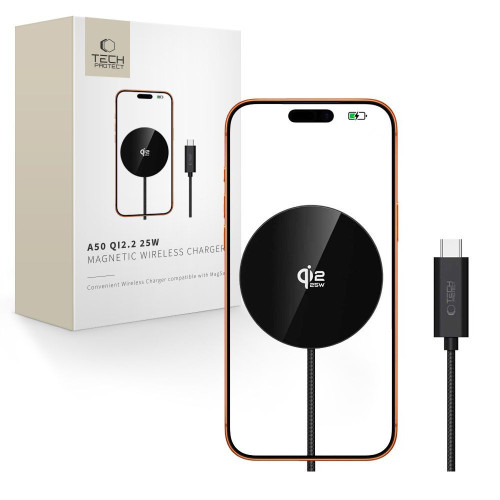
Tech-Protect A50 MagSafe 25W Qi2.2, single disc
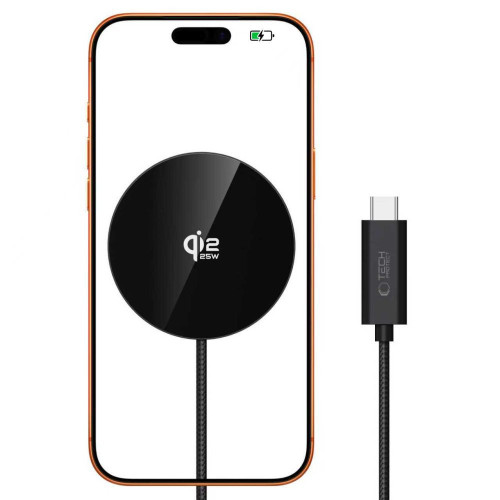
Our choice among inductive chargers
Tech-Protect A50 delivers a full 25 W for the phone, as all the power goes into one field. It is the simplest form possible: a magnetic disc on a cable.
The magnet holds securely despite the 254 grams of the Duo. If you prefer a different finish, the same manufacturer offers Tech-Protect A54 Qi2.2.
Tech-Protect A51 ArcticBoost 3in1, full 25 W for the phone
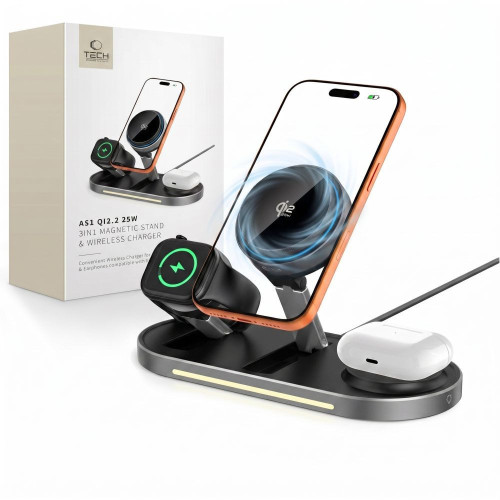
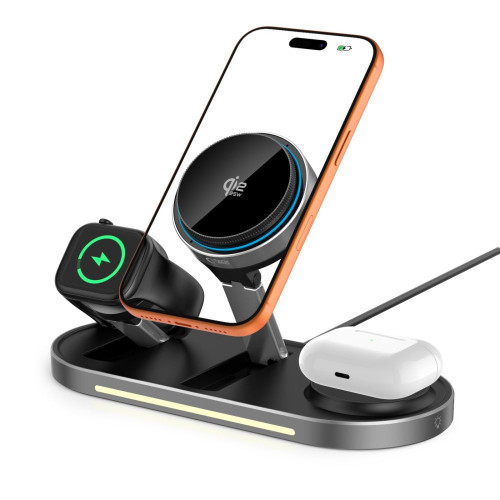
Tech-Protect A51 ArcticBoost is a rare case of a 3-in-1 station where the phone receives a full 25 W, while the watch and headphones have their own power budget alongside. The manufacturer requires at least a 45 W power supply for this.
Additionally, it has active cooling. Inductive charging inherently generates heat, and heat is the main enemy of battery life, so at 25 W this is a real value, not marketing. A cheaper alternative is Tech-Protect A52 3in1 Qi2.2, also with 25 W for the phone, but without a fan and requiring 40 W on the power supply.
Satechi 3-in-1 Qi2, foldable stand with 15 W
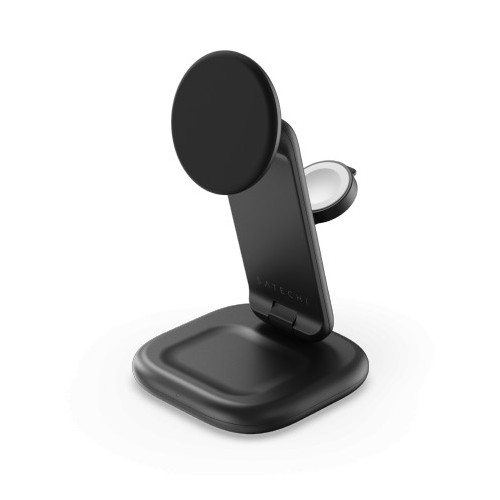
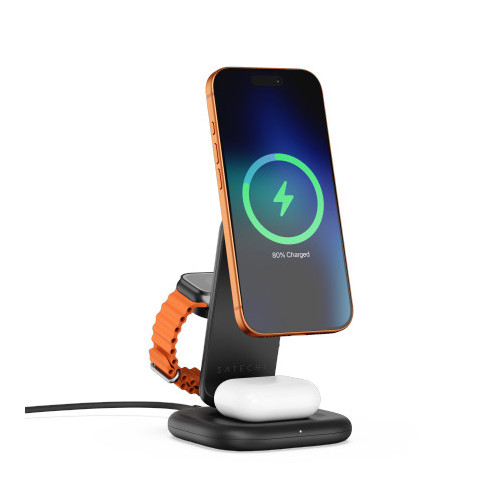
Satechi 3-in-1 Qi2 holds a phone, watch, and headphones, and the Duo stand keeps the phone upright, so you can see notifications on the external screen without picking up the phone. When folded, it takes up little space, making it a sensible travel charger.
Note the power: the manufacturer states 15 W for the iPhone, despite the „25W” in the name. For overnight charging, this doesn’t matter; for daytime top-ups, a model with the full 25 W would be better.
Satechi Qi2 Trio Wireless Charging Pad, flat mat 15 W
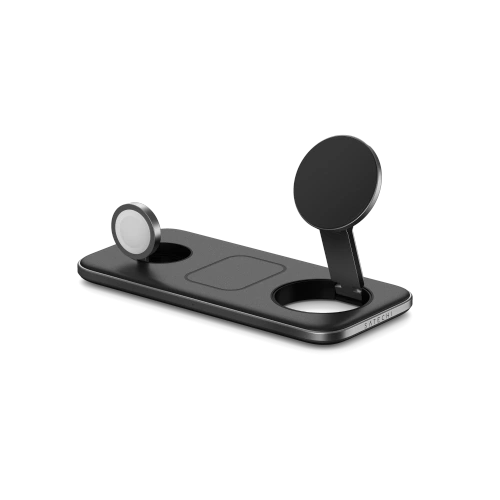
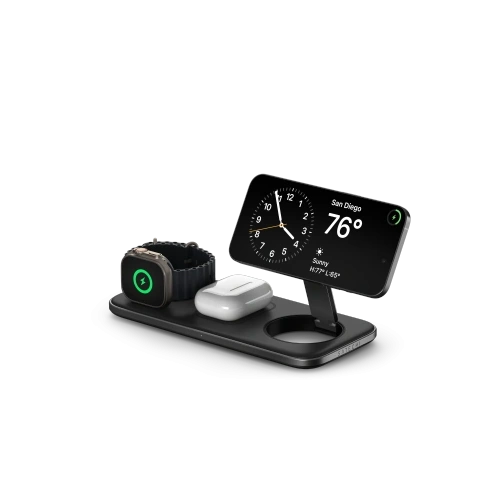
Satechi Qi2 Trio is the same idea in a flat version, also with 15 W for the phone. The Duo lies horizontally instead of standing, which makes sense on a nightstand where a stand would block the alarm clock or lamp.
With a foldable phone, a flat mat has one more advantage: you can place the Duo closed on it without stressing the hinge.
25 W wireless chargers and 3-in-1 stations


We gathered a broader overview of this category in the guide which MagSafe charger to choose, and you can find the full offer in the wireless chargers category.
USB-C Cables: This is where you can easily lose the promised 60 W
The cable from the Duo box is one meter long and carries the required power. The problem arises when you need a second cable: a longer one for the bed, a shorter one for the backpack, or a spare one for work.
A 60 W charging cable must carry 3 A at 20 V. This is the upper limit for a regular USB-C cable: above 3 A, the cable must have an e-marker chip that informs the charger of its capabilities. The Duo fits exactly within this limit, so a decent cable without an e-marker will suffice, but it operates at the edge.
Three numbers worth watching in the description:
- Current: 3 A is exactly what you need; 5 A provides a buffer and ensures that the bottleneck is the charger, not the cord
- Power: 100 W and 240 W cables carry the required 60 W well within their limits
- Data speed: a separate parameter, completely unrelated to power
This last thing is the most surprising. Most 100 W cables transmit data at USB 2.0 standard, which is 480 Mb/s. The Duo has a USB 3 connection with a bandwidth of 10 Gb/s, so when transferring video material, the difference is more than twenty times.
This also applies to both cables below: both charge at full power, both transmit data in USB 2.0. If you are looking for a cable for fast recording transfers, check the transfer speed separately, as it is a completely different product category.
Tech-Protect UB20T Ultraboost 100W, spring cable for car and desk
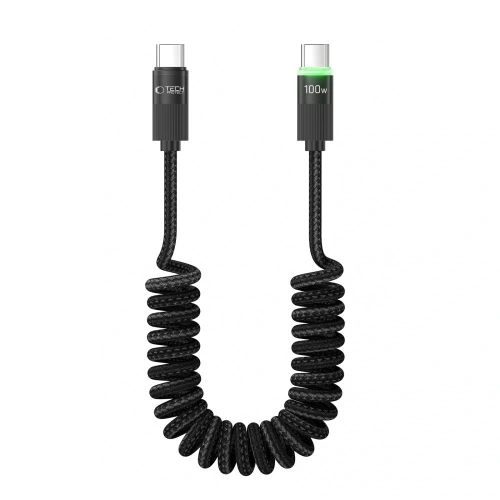
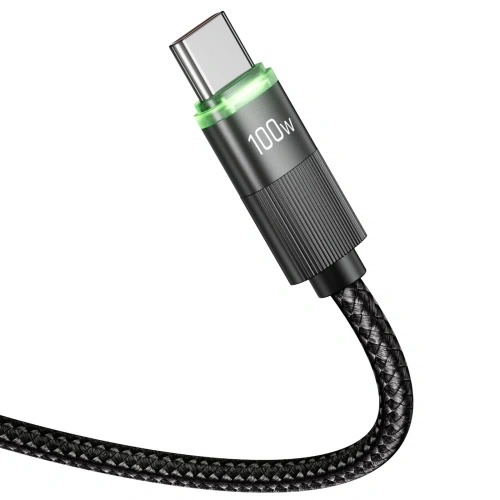
Tech-Protect UB20T Ultraboost cable supports 100 W at 5 A, which is well above the 3 A required by the Duo.
Its construction is spring-loaded: at rest, it coils down to a few centimeters and stretches up to 180 cm. In the car and on the desk, this means the end of tangles, as the cable returns to shape instead of lying in a knot.
Tech-Protect UB10T Ultraboost 240W, with extra for a laptop

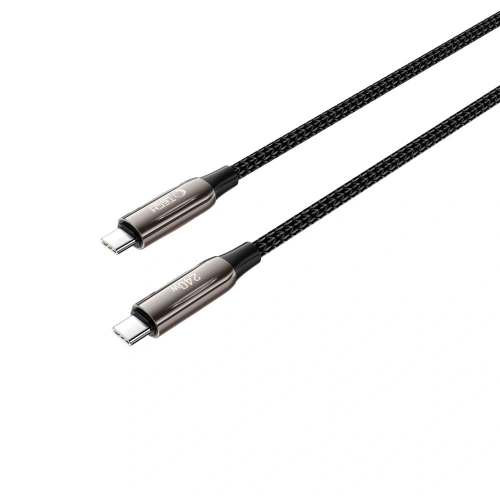
Tech-Protect UB10T Ultraboost cable transfers 240 W in EPR extension from the USB PD 3.1 standard. For a phone, it’s an overkill, but if the same cable sometimes needs to power a laptop, you buy one cable instead of two.
A meter length works well at the desk and in the backpack. For a permanent workstation at the computer, a shorter and cheaper Tech-Protect Ultraboost DNA 100W is sufficient.
More about choosing the cable is written in the article which fast charging cable to choose. The full offer is in the USB-C cables category.
Car chargers for iPhone Duo
Duo claims up to 24 hours of typical usage, but two screens can quickly eat through that. In the car, different factors matter than at the desk: navigation on a large internal screen drains the battery faster than a weak charger from the cigarette lighter can charge it.
The principle is the same as with a wall charger. The car charger must provide 60 W on one port for the phone to charge at full speed. Popular 18 W or 30 W adapters will maintain the battery level during navigation, but will not raise it.
Wireless charging mount Tech-Protect MM25W-V8
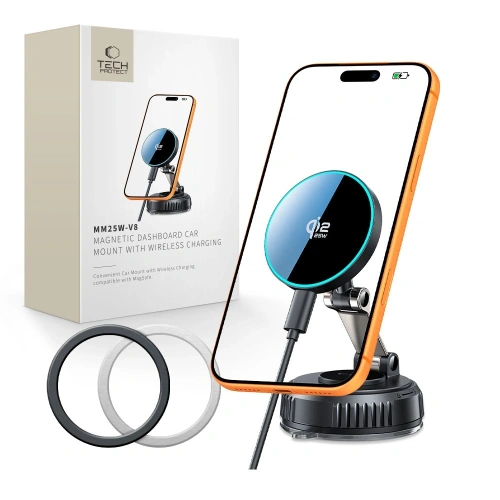
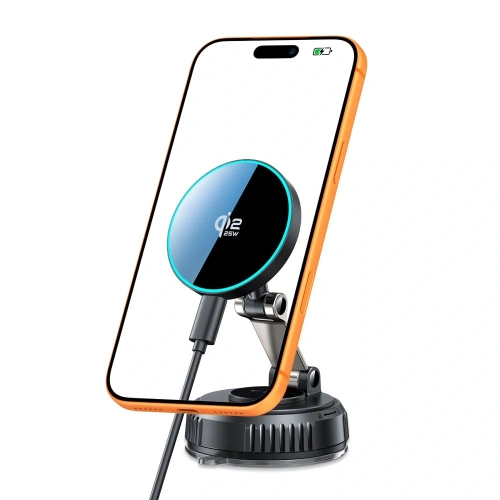
Tech-Protect MM25W-V8 Mount combines a windshield or dashboard mount with a 25 W Qi2.2 charger. You attach your phone magnetically and it starts charging immediately, without plugging in the connector every time you get in.
With Duo, there’s one more benefit: the mount keeps the phone secure, so you don’t stress the hinge while on the road.
UGREEN EC705 130W, for the driver with a laptop
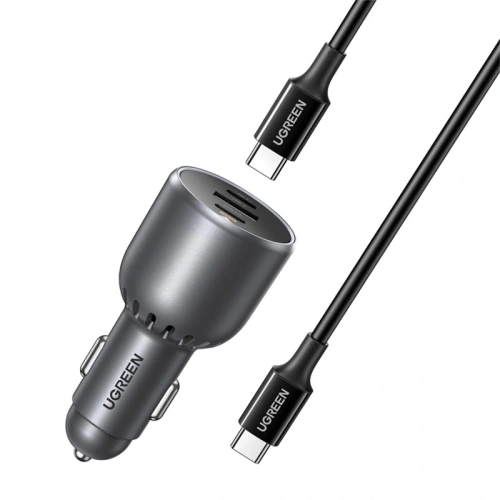
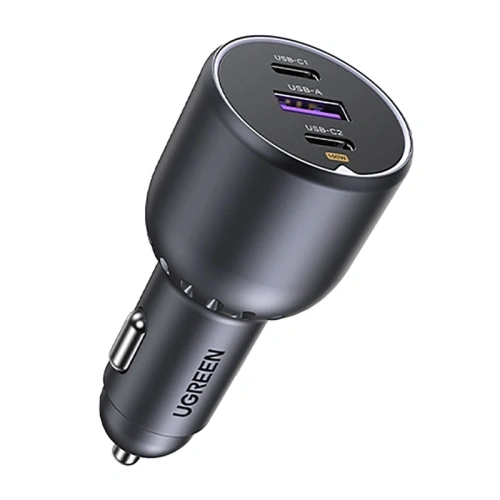
UGREEN EC705 charger provides 130 W across three ports, so your phone gets its 60 W even when a laptop or passenger tablet is charging next to it. The package includes a 5 A cable, which is exactly what is required for full power.
An alternative with two USB-C ports is the Tech-Protect CC03 100W.
Note on descriptions: car chargers described as “PD 60W” often split this power between ports, for example, 30 W on USB-C and 18 W on USB-A. For Duo, only the number at the USB-C port matters, not the total from the box.
We described more options in the guide fast car charger, and the full offer is in the car charger category.
Power banks for iPhone Duo
A power bank for a foldable phone is chosen differently than for a regular smartphone, for one reason: Duo weighs 254 g. This is clearly more than a classic iPhone, so a magnetic power bank attached to the back turns the set into something you don’t want to hold to your ear for half an hour.
Hence a simple rule: magnetic up to 10,000 mAh or wired above. Heavier cells are better kept in your pocket and connected with a cable.
Tech-Protect PB40 LifeMag 10,000 mAh, magnetic with full Qi2.2 power
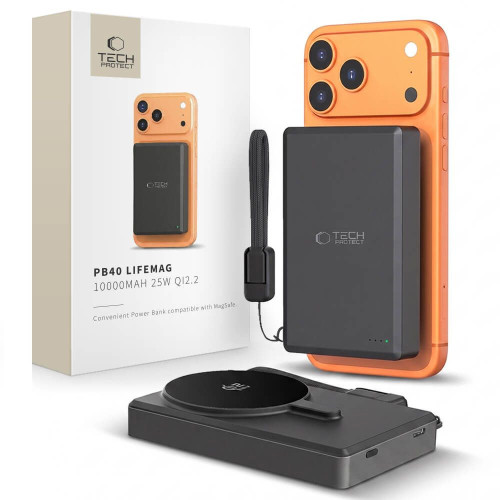
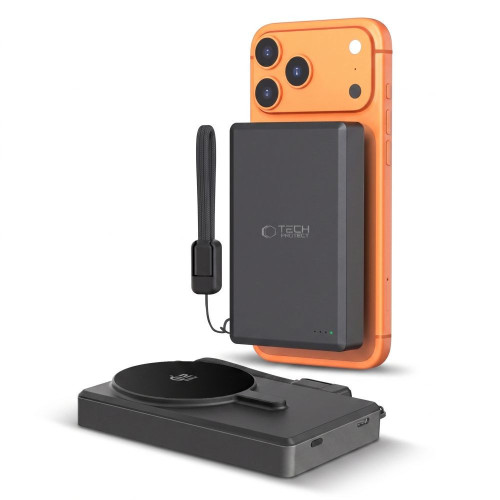
Tech-Protect PB40 LifeMag power bank has 10,000 mAh and charges wirelessly in the Qi2.2 standard with a power of 25 W, which is as much as Duo can accept without a cable. You attach it to the back of your phone and go on.
It’s the most convenient solution for the city: charging starts the moment you place it, without searching for a plug in your pocket.
UGREEN PB773 10,000 mAh 30W, magnetic with USB-C port
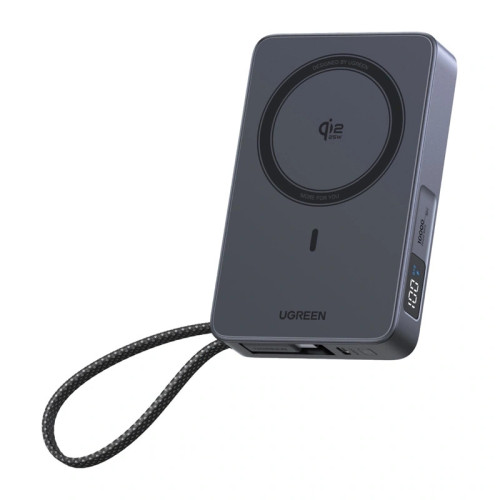
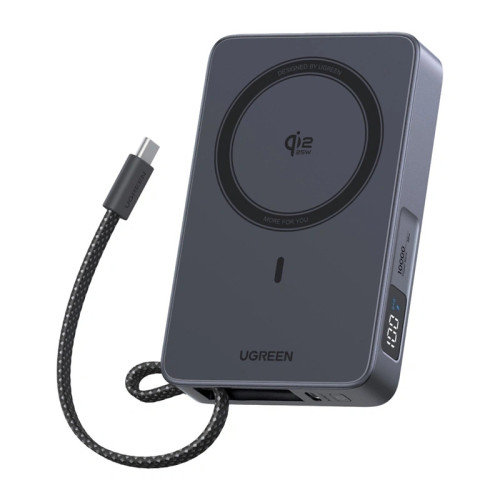
UGREEN PB773 power bank combines magnetic mounting with a 30 W USB-C port. You wirelessly add energy on the go, and charge faster with a cable when you have a moment to stop.
Thirty watts through the cable won’t give the claimed 20 minutes to half by Apple, but it still exceeds the 25 W available wirelessly.
UGREEN PB726 20,000 mAh 165W, for longer trips
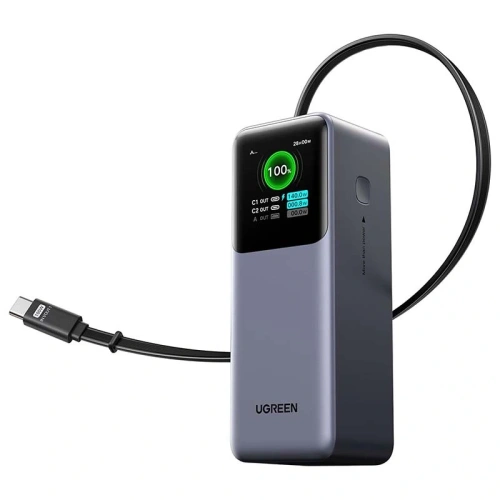
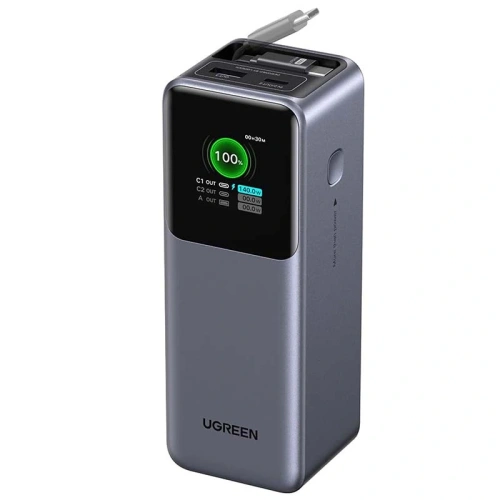
UGREEN PB726 Powerbank is in a different league: 20,000 mAh and 165 W, which means it can charge Duo at full speed and still have power left for a laptop. The built-in retractable cable also solves the problem of always missing a cable.
This powerbank is for a backpack, not for a pocket. However, on a two-day trip without access to a socket, it replaces the rest of this article. If you care about power with less weight, check out UGREEN PB537 20,000 mAh 55 W.
Pre-flight advice: as of March 27, 2026, new ICAO rules apply. Each passenger is allowed a maximum of two powerbanks, each up to 100 Wh (20,000 mAh is about 74 Wh, so it fits within the limit). They may only be carried in the cabin, must be kept within reach, not in the overhead compartment, and cannot be recharged from onboard sockets.
Powerbanks, cables, and charging on the go


We have gathered more models in the 2026 powerbank ranking, and you can find the entire offer in the powerbank category.
Which charger to choose? Recommendations based on needs
| Your situation | What to buy | Why |
|---|---|---|
| You want one charger and don’t want to think | UGREEN Nexode Air 65W | Meets the threshold, is small, has three ports for backup |
| You charge your phone and laptop from one socket | Tech-Protect PowerVision NC100W | One hundred watts for both, and the display will show how much is actually flowing |
| You travel a lot | Satechi 4-Port GaN Travel 140W | Interchangeable plugs replace a set of adapters |
| You mainly charge at night by the bed | Tech-Protect A50 or Satechi Qi2 Trio with the appropriate power supply | During eight hours of sleep, speed doesn’t matter |
| You already have a strong charger for your MacBook | Nothing or just the cable | Check how much it delivers on one port; 60 W+ is enough |
| You need a second cable | Tech-Protect UB20T 100 W / 5 A | Has more than the required 3 A, won’t cut power |
| You drive with navigation | Tech-Protect MM25W-V8 mount or UGREEN EC705 | A weaker adapter will maintain battery level but won’t raise it |
| You’re going away for a longer time without a socket | UGREEN PB726 20,000 mAh | Magnetic 10,000 mAh is for convenience, not capacity |
You are choosing between the Duo and Samsung’s foldable. We compared both in the comparison of iPhone Duo and Galaxy Z Fold 8, and a separate ranking of chargers for Samsung can be found in the text about chargers for Galaxy Z Fold 8 Ultra.
Summary
The Duo charger for iPhone comes down to one number and three details surrounding it.
- The power supply must be at least 60 W, otherwise you won’t see the promised 50% in 20 minutes
- What matters is the power on one port, not the total written on the box
- The cable must carry 3 A at 20 V, so 100 W and 5 A cables are a safe choice
- Wirelessly you will get 25 W via MagSafe or Qi2 25W, but the pad needs its own power supply, from 35 to 45 W depending on the model
- There is no power supply in the box, only a USB-C cable, so the brick needs to be purchased separately
The rest of the equipment revolves around the same thresholds, with one exception. The power bank is chosen not for power, but for the weight of the phone: magnetic up to 10,000 mAh, heavier cells on a cable.
If you have to buy one thing before picking up the phone, let it be a 65 W charger with USB Power Delivery. The rest, from the induction pad to the power bank, can wait until you learn your habits with the new phone.
At least 60 W. Apple states that with a 60 W or stronger power adapter, the phone will charge to 50% in about 20 minutes. Weaker chargers will work, but slower.
Can you charge the iPhone Duo with a 65 W charger?
Yes, and it is actually recommended. The phone only draws as much power as it needs, and a higher wattage charger never „forces” it. A 65 W power adapter provides a small buffer above the required threshold.
Is a 67 W charger good for the iPhone Duo?
Yes, and it is one of the better choices. Seven watts above the required 60 W threshold provides a buffer that allows the phone to maintain full speed even when you connect headphones or a watch to the second port.
Can the iPhone Duo be charged with a 100 W or 140 W charger?
It is possible and completely safe. USB Power Delivery negotiates the voltage and current between the charger and the phone, so the device draws only as much as it can handle. A more powerful charger is useful when charging multiple devices at once.
Does the iPhone Duo need an original Apple charger?
No. Any power adapter that supports USB Power Delivery with a power of 60 W or higher is sufficient. Apple does not require MFi certification for wall chargers, and for wireless charging, compatibility with the Qi2 standard is what matters.
Is there a charger included with the iPhone Duo?
No. In the box, you will find only a 1-meter USB-C cable. The wall adapter needs to be purchased separately, just like with every iPhone since 2020.
How fast does the iPhone Duo charge?
Up to 50% in about 20 minutes with a 60 W or stronger adapter. MagSafe and Qi2 wireless charging works with a power of up to 25 W, so a full charge takes significantly longer than with a cable.
Will an old 20 W charger from the iPhone charge the Duo?
It will charge, but much slower than Apple states. The foldable iPhone has two batteries, and with a 20 W adapter, the charging time increases several times compared to the stated 20 minutes to reach half capacity.
Sources:
Comments
No comments yet. Be the first!

![iPhone Duo Case: Which One Protects the Hinge? Ranking [2026]](/_next/image?url=https%3A%2F%2Fblog.trkhspl.com%2Fwp-content%2Fuploads%2F2026%2F10%2FApple-iPhone-Duo-opening-iPhone-Duo-260909.jpg.large_2x-scaled.jpg&w=1200&q=75)
